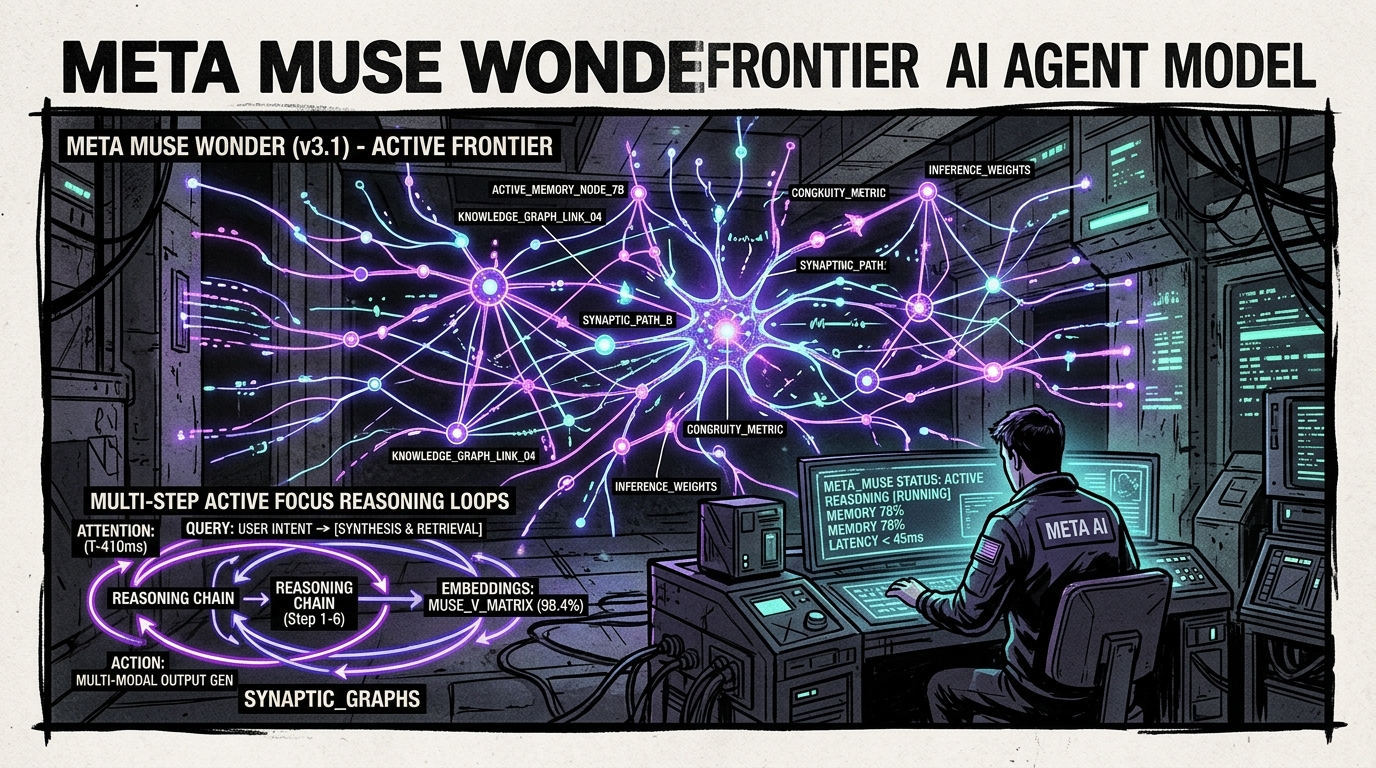
On October 12, 2026, Meta announced its latest frontier model family: Muse Wonder and Muse Wonder Full. Positioned squarely for personal and professional agentic tasks, Meta's release moves beyond static prompt-response chatbots into autonomous systems that maintain long-term memory across sessions and persist through complex multi-step objectives.
Meta highlights two signature architectural capabilities in the launch announcement: Active Memory (the ability to carry forward relevant context, project rules, and user preferences across separate conversations) and Active Focus (the capability to autonomously work toward multi-hour goals, test alternatives when hitting roadblocks, and request confirmation before taking irreversible actions).
Muse Wonder is rolling out to developers through the Meta Model API and Muse Code, while the flagship Muse Wonder Full model is offered to Muse Code enterprise subscribers. Below is an in-depth technical analysis of its features, developer access, and unanswered privacy questions.
Understanding Active Memory: Persistent context in plain language
One of the biggest pain points in today's AI agent workflows is context loss: when a session ends or hits its token ceiling, the model forgets architectural decisions, user preferences, and previous bugs. Developers often build complex external vector databases or retrieval-augmented generation (RAG) pipelines to bridge this gap.
Active Memory internalizes this pattern directly within Meta's model layer. Rather than treating each API call as isolated or relying solely on manual prompt injection, Muse Wonder maintains an indexed semantic layer of prior interactions:
- Cross-Conversation Retention: Remembers user coding conventions, preferred libraries, repository quirks, and ongoing project status without needing them re-pasted in every prompt.
- Selective Memory Consolidation: Periodically summarizes and prunes transient noise while preserving durable knowledge (such as schema definitions, deployment endpoints, and security policies).
- User-Controlled Memory Inspection: Meta states users can inspect, edit, or delete items stored in their Active Memory profile via privacy settings.
Understanding Active Focus: Autonomous persistence, retries, and guardrails
While Active Memory provides historical continuity, Active Focus governs how the model executes long-horizon tasks. Meta describes it as a combination of three behavioral mechanisms:
1. Goal Persistence: The agent tracks progress against a multi-step objective, ensuring it does not lose sight of acceptance criteria when diving deep into subroutines.
2. Autonomous Error Recovery: When a shell command fails, a unit test throws an exception, or an API call returns a 429 status code, Active Focus tests alternative solutions rather than abruptly halting.
3. Human Confirmation Guardrails: For high-impact actions—such as sending client communications, purchasing services, running database migrations, or deleting production resources—the agent pauses to solicit human confirmation.
How Active Memory and Active Focus power multi-turn agents
Follow the step-by-step lifecycle of a Muse Wonder agent execution in the interactive workflow explorer below:
Stage 01: Context Intake & Persistent Memory Retrieval
Muse Wonder queries its persistent context memory layer across prior conversation sessions to surface user preferences, recurring schemas, and project constraints.
ACTIVE_MEMORY
Cross-Session Semantic Context Ingestion
Meta Model Memory Store
{ "user_context_keys": ["workspace", "active_project"], "recall": 0.94 }
Muse Wonder vs Muse Wonder Full at a glance
Meta is offering two distinct tiers within the Muse Wonder lineup. The table below outlines documented capabilities, target use cases, and distribution channels:
| Attribute | Muse Wonder | Muse Wonder Full |
|---|---|---|
| Target Workload | Everyday agentic tasks, fast coding, document Q&A | Complex multi-day research, deep refactoring, enterprise agents |
| Active Memory | Supported (Standard context retention) | Supported (Extended multi-project retention) |
| Active Focus | Standard retry & verification loops | Deep planning, extended self-correction & validation |
| Availability | Meta Model API & Muse Code Free/Pro | Muse Code Enterprise Subscribers |
| Intended Modalities | Text, Code, Documents | Text, Code, High-Resolution Multimodal Input |
| Open-Source Status | API Access Only (Weights not released at launch) | API Access Only (Hosted environment) |
Developer access: Meta Model API & Muse Code
Developers can access Muse Wonder through two primary pathways:
1. Meta Model API: Available to registered enterprise developers through Meta for Developers console. The API supports standard OpenAI-compatible endpoints with custom headers for x-meta-active-memory session binding and tool execution.
2. Muse Code Environment: Meta's native agentic development environment, providing an IDE companion that interfaces directly with local terminals, git repositories, and project dependency trees.
POST /v1/chat/completions HTTP/1.1
Host: api.meta.com
Authorization: Bearer $META_API_KEY
Content-Type: application/json

{
  "model": "meta-muse-wonder",
  "active_memory": {
    "session_id": "proj_anurag_automation",
    "retain_knowledge": true
  },
  "messages": [
    {
      "role": "user",
      "content": "Audit our n8n webhook error handlers against the security policy we established yesterday."
    }
  ]
}Privacy, data governance, and unanswered questions
Because Active Memory retains context across conversations, enterprise security teams must evaluate key governance questions:
• Data Retention & Deletion: What are the exact retention windows for memory embeddings? Does deleting a conversation purge associated memory vectors immediately?
• Training Boundaries: Meta's announcement emphasizes user controls, but enterprise teams will need explicit contractual guarantees that proprietary memory embeddings are excluded from foundation model pre-training.
• Safety Evaluation Timing: Meta indicated that a comprehensive third-party safety and red-teaming report would follow in coming weeks.
Frequently asked questions
What is Meta Muse Wonder? Muse Wonder is Meta's frontier AI reasoning and agent model family, featuring persistent cross-session memory and autonomous goal persistence.
What is the difference between Muse Wonder and Muse Wonder Full? Muse Wonder is designed for standard developer and personal tasks via the Meta Model API. Muse Wonder Full is the flagship long-horizon model reserved for Muse Code enterprise subscribers.
Is Meta Muse Wonder open source? No. At launch, Muse Wonder is accessible exclusively via hosted APIs and Meta products. Model weights have not been published under an open license.
How does Active Memory differ from normal chat history? Normal chat history is sent sequentially inside the prompt context window and is forgotten once a new session starts. Active Memory is indexed semantically across sessions, retrieving relevant facts when prompted.